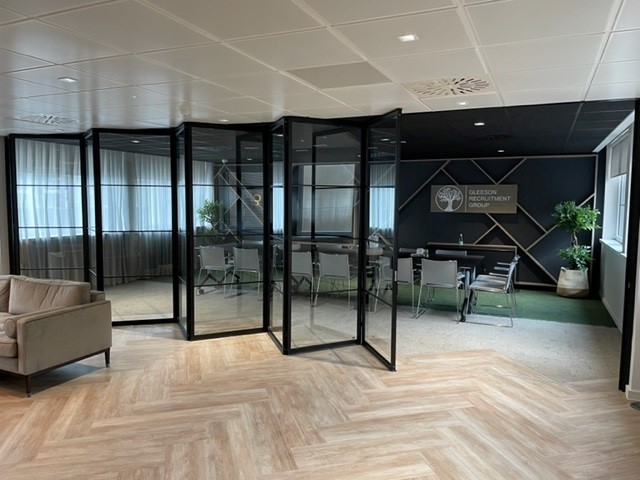
BB93 Compliant Acoustic Partitions for Schools: A Guide for Architects and Specifiers
Building Bulletin 93 (BB93) sets the acoustic performance standards for school buildings in England. For movable walls and operable partitions used in schools, meeting BB93 requirements is essential. This guide explains what BB93 means for the specification of acoustic partitions and movable wall systems in educational buildings.
Building Bulletin 93 (BB93) — Acoustic Design of Schools — sets the acoustic performance standards for school buildings in England. Published by the Department for Education, BB93 defines the minimum sound insulation, reverberation and background noise requirements for different types of spaces within school buildings, including classrooms, halls, sports facilities and music rooms.
For movable walls and operable partitions used in schools — whether dividing a hall into teaching spaces, creating flexible classrooms, or separating a sports hall for simultaneous activities — meeting BB93 acoustic requirements is a critical specification requirement. Architects and acoustic consultants must ensure that the specified partition system achieves the performance levels required by BB93 for the intended application.
BB93 requires that partitions between teaching spaces achieve a minimum Dn,w of 45 dB for general classrooms, rising to 50 dB or above for spaces adjacent to music rooms, drama studios or sports halls where higher levels of noise are generated. When specifying movable acoustic walls and operable partitions for schools, architects should ensure the specified Rw rating is sufficient to meet the BB93 Dn,w requirement for the application.
ModernGlide movable acoustic wall systems are widely specified in school buildings across the UK. Our MG100 system achieves acoustic ratings up to Rw 59 dB — well above the BB93 minimum for all educational applications. The MG200 floor-supported hinged folding partition achieves up to Rw 49 dB, making it suitable for most school hall and classroom division applications.
When specifying movable acoustic walls for BB93 compliance, architects and acoustic consultants should be aware that the Rw rating of a partition is a laboratory test value measured under controlled conditions. In-situ performance may be lower due to acoustic flanking transmission through the building structure, floor, ceiling and walls adjacent to the partition. A flanking allowance of typically 5–8 dB should be applied when selecting a system to ensure the required Dn,w is achieved in practice.
Correct installation is also critical to achieving BB93 compliance. ModernGlide installs all systems using FIS-accredited operatives, and our installation teams are experienced in working within school buildings to ensure that acoustic seals, panel alignments and track systems are installed to the standard required to achieve rated acoustic performance.
For school projects where BB93 compliance is required, ModernGlide can provide full acoustic performance documentation including test certificates, Rw ratings and guidance on flanking allowances. Our technical team can advise on system selection and specification to ensure your project meets BB93 acoustic requirements. Contact us to discuss your school project and request a technical pack.
Article Info
- Published
- January 2026
- Category
- Technical Guide
Related Products
Keep Reading
Related Articles
Industry InsightsMovable Wall Systems: Transforming Flexible Acoustic Spaces for Modern Offices and Education
 Product Guide
The ModernGlide MG100 Movable Acoustic Wall: An Overview
 Product Guide