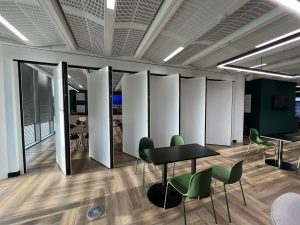
Acoustic Performance of Movable Walls: Understanding Rw Ratings
Understanding acoustic performance ratings is essential when specifying movable acoustic walls and operable partition systems. This guide explains Rw ratings, the difference between laboratory and in-situ performance, and how to select the right acoustic partition.
When specifying movable acoustic walls and operable partition systems, understanding acoustic performance ratings is essential. The Rw (weighted sound reduction index) is the primary measure of a partition's acoustic performance, and it is the value you will see quoted in product specifications and NBS clauses.
The Rw rating is measured in a laboratory under controlled conditions, using a standardised test method (ISO 10140). The higher the Rw value, the better the acoustic performance of the partition. ModernGlide systems range from Rw 33 dB for basic sliding panel systems up to Rw 59 dB for the flagship MG100 movable acoustic wall.
It is important to understand that the Rw rating is a laboratory value measured under ideal conditions. In practice, the acoustic performance of a partition installed in a building will typically be lower than the laboratory Rw rating, due to acoustic flanking transmission — sound travelling around the partition through the floor, ceiling, walls and structural elements.
The in-situ acoustic performance is expressed as Dn,w (weighted normalised level difference) or Dw (weighted level difference), and is typically 5–10 dB lower than the laboratory Rw rating. When selecting a movable wall system to meet a specified acoustic performance requirement — such as BB93 for schools — architects should ensure the system's Rw rating is sufficient to achieve the required Dn,w after allowing for flanking.
ModernGlide can provide detailed acoustic performance data for all systems in our range, including laboratory test certificates, Rw ratings and guidance on flanking allowances. Our technical team can advise on system selection to ensure your project meets its acoustic performance requirements.
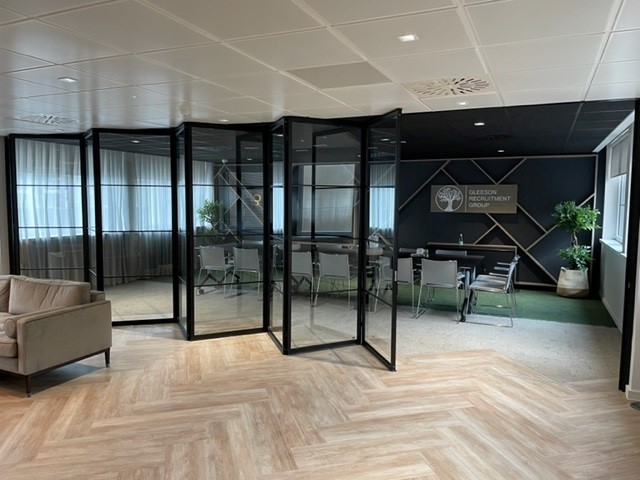
For offices and commercial spaces, the required acoustic performance depends on the nature of the activities on each side of the partition. Speech privacy for confidential meetings typically requires Rw 45–55 dB, while open-plan office subdivision may only require Rw 35–45 dB. Our glazed systems — the MG500, MG600 and MG900 — provide a good balance of acoustic performance and visual connectivity for office environments.
Correct installation is as important as product selection in achieving the specified acoustic performance. ModernGlide installs all systems using FIS-accredited operatives, and our installation teams are trained to ensure that acoustic seals, panel alignments and track systems are installed correctly. We provide commissioning documentation and can arrange acoustic testing on completion if required.
Article Info
- Published
- January 2025
- Category
- Technical Guide
Related Products
Keep Reading
Related Articles
 Technical Guide
BB93 Compliant Acoustic Partitions for Schools: A Guide for Architects and Specifiers
Technical GuideHow to Specify Operable Walls: A Practical Guide for Architects
 Industry Insights